Shakespeare, like Duke Ellington, wrote for his players: http://www.the-tls.co.uk/tls/public/article1351065.ece
(h/t http://www.aldaily.com/)

Thursday, December 12, 2013

Friday, November 15, 2013
A Quick Look at Improvised Counterpoint
It is widely understood that
counterpoint played an important role in the musical thinking of Lennie
Tristano. His improvised piano solos occasionally exhibit the contrapuntal
interaction of two independent lines (or more, as in the case of the
multi-tracked “Turkish Mambo”), and his ensembles frequently engaged in “collective
improvisation,” in which multiple players simultaneously improvise melodies
(i.e., polyphony).
Perhaps less widely discussed, however,
is the technique guiding such improvised counterpoint. How do the independent
voices relate to each other? For performances of compositions from the American
Songbook, a given chord sequence will obviously circumscribe the harmonic
content of the improvisation (unlike purely free-improvised pieces like
“Intuition” and “Digression”). But is that the full extent of the musical
coherence, or can we discover other significant relationships between the
voices in Tristano-school counterpoint?
In the second bar of the form, Marsh
introduces a motive which outlines a four-note stepwise ascent. Following by
one beat and before Marsh’s statement is completed, Konitz answers with the
retrograde version of the motive. Konitz repeats the retrograde form of the
motive in bar 4, this time transposed down a diatonic step, and he follows in
bar 5 with a varied form of the descending motive which foreshadows later
motivic developments. The original ascending form of the motive returns in
Marsh’s line in bar 6, where it is roughly played twice in succession. Finally, Konitz answers in bars 7 and 8 with an
elaborated statement of the ascending motive, outlining G-A-B-flat-C, plus the
falling third (B-flat-G) as when we first heard the motive from Marsh. Konitz’s
final sounding of the motive is put into relief by the fact that it clearly
outlines G minor, anticipating the formal harmonic arrival of this chord by a
measure and a half.

In addition to its motivic coherence, this
passage is also interesting for its elegant higher-level voice-leading. In the
first four measures, Konitz embellishes a descending stepwise line of F(bars 2–3)-E-D-C(bar
4)---an instance of the motive in retrograde---while Marsh in contrary motion ascends by step from F (bar 2, heard in the
upper octave) through G (bar 3) to A (bar 4). Konitz and Marsh seem to
simultaneously anticipate the F chord of bar 5 by placing chord tones (C and A,
respectively) on the final beat of measure 4. Measure 5 finds the two players
exchanging voices, C for neighbor-note embellished E, and another
voice-exchange in the following measure switches F and D-flat (C-sharp) on beat
one and the upbeat of three. Konitz and Marsh reach a unison E-flat, from above
and below, respectively, in bar 7. The prevalence of consonant thirds and
sixths between the two voices in these bars is noteworthy.

Another period of imitative cohesion
arises in measure 12 beginning with Konitz’s stepwise “down-up” motive (which
at least in terms of its initial pitch content seems related to the original
motive of measure 2). After stating the motive, Konitz repeats it four times
at different pitch levels through measure 15. Marsh follows behind by a bar,
imitating the “down-up” motive in measures 13 and 14. Note the contrary-motion
3-6 progression onto the strong beat 3 in bar 13 and the parallel thirds on the
first two beats of bar 14. Konitz’s phrase-ending ^3-^1 descent in bar 15 is
inverted and lengthened to two measures as Marsh responds with the ascending
sixth in bars 15–16.

The start of the second half of the form
finds Konitz reactivating the preceding motive, this time in inversion (“up-down”)
at the same pitch level as in bar 12 and immediately elided with a form of the
original (“down-up”) at the third below. Konitz returns to this motive in its full
form in bars 19–20, and then isolates the “down-up” fragment in bar 21. In
measures 22–24 Konitz reverses the order of the motive fragments for two
statements of “up-down + third descent / down-up,” with the first half of each
accelerated rhythmically as sixteenth notes. Marsh’s imitation, meanwhile,
consists of a two-fold answer to the “up-down” motive segment with descending
third in bar 18, which then spins off a chromatic ascent of the minor third
dyad to bar 21.


Finally, the technique of voice-exchange
heard earlier returns in bars 31–32, where two chromatic instances of it, first
exchanging C for A and then F for A, outline the chromatically-inflected tonic triad. This final passage also includes an example each of the chromatically-ascending minor third dyad and the falling third, both of which are motivically salient due to their earlier appearances in the music discussed above.

Monday, October 28, 2013
Lennie Tristano on Twelve-Tone Improvisation
"... I even tried a bit of twelve-tone composition and struck up a correspondence with the pianist Lennie Tristano, the most 'advanced' jazz musician of that time [the early 1950s], in which I helpfully pointed out that the twelve-tone method obviously also held the key to the future of jazz. (Tristano gently replied that I seemed not to have too much acquaintance with jazz improvisation, and was kind enough to invite me to come and talk with him. We shared a turkey sandwich one Thanksgiving evening.)"William H. Youngren, "Schoenberg, Rosen, and the Common Listener," 1978.
Thursday, September 5, 2013
Coltrane Cycles and the Blues
Jazz is a syncretistic music, and I therefore believe that it requires a heterogeneous approach to analysis.
In a previous post, I discussed Coltrane's chromatic major third cycles in terms of harmonic implications derived from the principles of tonality. Scholars like William Rothstein, Matthew Bribitzer-Stull, and David Kopp have traced the history of the chromatic major third full cycle (I-bVI-III#-I) back to examples in Schubert and Rossini, and they demonstrate how such chromatic mediant relationships abounded throughout nineteenth-century music. It is apparent that Coltrane's application of the major third cycle belongs in this lineage, perhaps as mediated by Slonimsky.
It would be an obvious mistake, however, to neglect to have an ear to the blues when analyzing jazz music, especially the music of an artist like John Coltrane.
In his book Origins of the Popular Style, Peter van der Merwe persuasively describes the melodic practice of the blues as consisting partly of a "process of piling up thirds" (124):
Listening to any of his improvisations on "Impressions" reveals that what is typically misconstrued as "Dorian modality" is instead Coltrane's version of just such a blues-derived, "ladder-of-thirds" melodicism. The so-called "mode" is most often a six-note scale abstracted from the stacks of thirds on top of and below the tonic: i.e., D-F-A-C and D-B-G.
There is, then, a sense in which it might be appropriate to think of Coltrane's emphasis on chromatic (major and minor) third relations and cycles as a translation into harmonic terms of the "ladder of thirds" melodic concept that Van der Merwe finds central to blues practice. When Coltrane prolongs a harmony with digressions through third-related keys, I suggest that he is "composing-out" the pendular or stacked thirds of a higher-level blues melody.
Another element of blues melody comes to the fore in conjunction with Coltrane's mediant-based harmony: the variable third. According to Van der Merwe,
When Coltrane moves from a minor tonic to the major mediant, for example, or from a major tonic to the major submediant, the major third and minor third of the tonic key will be intermixed. As just one example from Coltrane's playing, this excerpt from the eleventh and twelfth bars of "Countdown" illustrates:

Here Coltrane is in the act of traversing from D major to B-flat major via F7, but in these five beats one hears only the collection (D E F F# G A). These are simply scale steps 1-2-3-4-5 in D, where scale step 3 includes both the major and minor variants.
When taken all together, the pitch classes of the three triads contained in a chromatic major third cycle (I-bVI-III#-I) yield the hexatonic collection, set class (014589). This collection consists of two augmented triads a semitone apart. Coltrane used two hexatonic scales as a basis for his composition "One Down, One Up," for instance.

Notably, the hexatonic collection contains major and minor triads built on shared roots. Thus a possible non-discrete tetrachordal subset of the hexatonic collection is set class (0347), shown in the example above. Bearing the intervals of a minor third, major third, and fifth, an example of this set class is (D F F# A). This is a "triad" with the variable third that Van der Merwe describes as a hallmark of blues melody.
It appears therefore that the hexatonic collection and the blues have a certain affinity, which John Coltrane succeeded in making audible.
In a previous post, I discussed Coltrane's chromatic major third cycles in terms of harmonic implications derived from the principles of tonality. Scholars like William Rothstein, Matthew Bribitzer-Stull, and David Kopp have traced the history of the chromatic major third full cycle (I-bVI-III#-I) back to examples in Schubert and Rossini, and they demonstrate how such chromatic mediant relationships abounded throughout nineteenth-century music. It is apparent that Coltrane's application of the major third cycle belongs in this lineage, perhaps as mediated by Slonimsky.
It would be an obvious mistake, however, to neglect to have an ear to the blues when analyzing jazz music, especially the music of an artist like John Coltrane.
In his book Origins of the Popular Style, Peter van der Merwe persuasively describes the melodic practice of the blues as consisting partly of a "process of piling up thirds" (124):
"In short, the blues mode takes the form of a ladder of thirds, but it is a flexible ladder that can be extended up or down at will." (125)
Listening to any of his improvisations on "Impressions" reveals that what is typically misconstrued as "Dorian modality" is instead Coltrane's version of just such a blues-derived, "ladder-of-thirds" melodicism. The so-called "mode" is most often a six-note scale abstracted from the stacks of thirds on top of and below the tonic: i.e., D-F-A-C and D-B-G.
There is, then, a sense in which it might be appropriate to think of Coltrane's emphasis on chromatic (major and minor) third relations and cycles as a translation into harmonic terms of the "ladder of thirds" melodic concept that Van der Merwe finds central to blues practice. When Coltrane prolongs a harmony with digressions through third-related keys, I suggest that he is "composing-out" the pendular or stacked thirds of a higher-level blues melody.
Another element of blues melody comes to the fore in conjunction with Coltrane's mediant-based harmony: the variable third. According to Van der Merwe,
"...[in] genuine blues tunes there will be no question of a clear-cut contrast such as we find between the classical major and minor... major and minor or neutral thirds may be juxtaposed throughout." (120).
When Coltrane moves from a minor tonic to the major mediant, for example, or from a major tonic to the major submediant, the major third and minor third of the tonic key will be intermixed. As just one example from Coltrane's playing, this excerpt from the eleventh and twelfth bars of "Countdown" illustrates:
Here Coltrane is in the act of traversing from D major to B-flat major via F7, but in these five beats one hears only the collection (D E F F# G A). These are simply scale steps 1-2-3-4-5 in D, where scale step 3 includes both the major and minor variants.
Notably, the hexatonic collection contains major and minor triads built on shared roots. Thus a possible non-discrete tetrachordal subset of the hexatonic collection is set class (0347), shown in the example above. Bearing the intervals of a minor third, major third, and fifth, an example of this set class is (D F F# A). This is a "triad" with the variable third that Van der Merwe describes as a hallmark of blues melody.
It appears therefore that the hexatonic collection and the blues have a certain affinity, which John Coltrane succeeded in making audible.
Thursday, August 29, 2013
Harmonic Tension in Coltrane's Chromatic Major Third Cycles
It is interesting to note that Coltrane’s chromatic major
third cycle was applied compositionally and improvisationally (too sharp a
distinction should not be drawn) in both the ascending and descending directions.
Ascent and descent have accordingly different musical effects. “Giant Steps”
and an excerpt from “Venus” may serve as examples.
The first seven bars of “Giant Steps” feature two incomplete descending chromatic major third cycles which are paired with descending melodies. The remainder of the composition reverses that direction for an ascending major third cycle with rising melody.
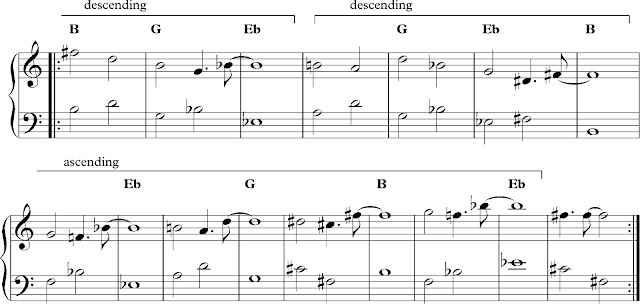
This excerpt from “Venus” (1:33-1:57 in the video below) illustrates an instance of the
ascending major third cycle complemented by an ascending melody, followed by a major third harmonic descent with descending melody.

In both cases, the ascending third cycle is accompanied by
the feeling of an increase in tension, while the descending third cycle brings
about the feeling of a dissipation of tension. This is partly due to the rising
and falling melodies, but there is also a harmonic component to the effect of
accumulating or lessening musical tension.
In Coltrane’s music, the chromatic third cycle has harmonic
implications inherited from the principles of tonality. The ascending major third
cycle (I-III#-bVI-I) moves each harmony four ticks in the sharp-key direction
along the circle of fifths (C-G-D-A-E...). In tonal music, harmonic
movement in the sharp-key direction is associated with an increase in tension. Conversely, the descending major third cycle (I-bVI-III#-I) moves each
harmony four ticks in the flat-key direction along the circle of fifths (C-F-B-flat-E-flat-A-flat…). Shifts to the flat-key area are generally associated with
the relaxation of musical tension. In addition, the III triad contains the
leading tone and (raised) fifth, and is therefore related to the dominant chord;
whereas the bVI triad contains the tonic and (flatted) sixth, thus relating it
to the subdominant chord.
The sense of building and releasing tension in these
examples, then, is overdetermined: both melodic contour and the harmonic implications
of the third cycle play important roles in creating the effect.
Wednesday, July 10, 2013
Prolongation in "Take the Coltrane"
A friend who is a brilliant trombonist as well as a medical doctor draws my attention to two outstanding excerpts from John Coltrane's solo on "Take the Coltrane." These turnaround phrases start in measures 9 and 8 of the blues form and can be heard in the video below at 1:49 and 2:10, respectively.


We hear Coltrane going "outside the changes" in a fashion not at all untypical of his playing in this period. It is clear, however, that there is no merely mechanical superimposition of "Giant Steps" or "Countdown" harmonies, as is so often and so glibly asserted. Rather, what we hear in these two examples is a fluid and spontaneous chromatic prolongation of a particular governing harmony.
The term "prolongation" is borrowed from Schenkerian theory and is meant to suggest that the chromatic harmonies heard in these excerpts represent not simple substitutions but an elaboration of a single higher-order harmony that obtains over the course of four and five measures. To illustrate this I have verticalized Coltrane's melody, adjusted note register to idealize the voice-leading, and used Schenkerian symbols to highlight higher-level relationships. (In the graphs below, the bass voice is derived from the implied root movement of the melody. Accidentals apply only to the pitch immediately following.)

In Example A, the foreground cycle of chords (C-B-E7-A-C7) prolongs a C chord, the dominant to the tonic harmony of this blues in F. Prolongation of the dominant is appropriate since this phrase begins in the ninth measure of the form. The sense of orderly departure from and return to the governing harmony gives the phrase a kind of centripetal logic. Coltrane uses a chromatic upper-neighbor motion to prolong the conceptual top voice C while the harmony moves through the chromatic lower mediant, itself preceded by secondary dominants. The conceptual bass voice returns to C via the subdominant minor, creating a III-IV-V ascent that effectively prepares the subsequent arrival of the tonic.
The phrase illustrated in Example B begins in the eighth measure and prolongs an F-sharp seventh chord, which is the "tritone sub" of the dominant or the Phrygian II, spelled enharmonically.

In this phrase, Coltrane pivots from the F-sharp seventh to a local resolution on B, followed by an incomplete cycle of chords whose roots descend by major thirds (B-G-E-flat). The cycle is related to "Giant Steps," although in this case the major chords are not mediated by intervening dominant chords. Through this prolongation the upper voice C-sharp descends by step to B-flat/A-sharp. Here the F-sharp harmony returns and is additionally expanded, this time by a lower neighbor tone in the conceptual upper voice and a passing tone in the conceptual inner voice. The melodic tones of the last measure can be heard as 6-5-2-3 in F-sharp or as 4-3-7-1 in B-flat minor, the subdominant to the tonic F which returns at the top of the form in the following measure. The latter hearing suggests a particularly grave sort of plagal cadence, and the leading-tone transformation of F-sharp major to B-flat minor reflects the type of major-third relation that Coltrane explored to great effect in this period.
This rising third also inverts the falling third from earlier in the phrase. It is worth noting that in both examples, the goal chord reached before the return of the chord of the governing harmony is the chromatic lower mediant (A in Example A, where the prolonged harmony is C, and E-flat in the F-sharp prolongation of Example B.).
Also notable in Example B is the stepwise descending third motive, heard twice at the foreground level in the inner voice (F-sharp-E-D-sharp, then E-D-sharp-C-sharp) and once at the middleground level in the upper voice (C-sharp-B-A-sharp). The descending third motive is also suggested by the bass movement from F-sharp to E-flat on the middle ground level and more loosely (in augmentation) by the foreground cycle, B-G-E-flat.
In my view, these excerpts offer evidence of hierarchical structure in Coltrane's improvisations, inviting analyses that make use of Schenkerian concepts like prolongation.
We hear Coltrane going "outside the changes" in a fashion not at all untypical of his playing in this period. It is clear, however, that there is no merely mechanical superimposition of "Giant Steps" or "Countdown" harmonies, as is so often and so glibly asserted. Rather, what we hear in these two examples is a fluid and spontaneous chromatic prolongation of a particular governing harmony.
The term "prolongation" is borrowed from Schenkerian theory and is meant to suggest that the chromatic harmonies heard in these excerpts represent not simple substitutions but an elaboration of a single higher-order harmony that obtains over the course of four and five measures. To illustrate this I have verticalized Coltrane's melody, adjusted note register to idealize the voice-leading, and used Schenkerian symbols to highlight higher-level relationships. (In the graphs below, the bass voice is derived from the implied root movement of the melody. Accidentals apply only to the pitch immediately following.)
In Example A, the foreground cycle of chords (C-B-E7-A-C7) prolongs a C chord, the dominant to the tonic harmony of this blues in F. Prolongation of the dominant is appropriate since this phrase begins in the ninth measure of the form. The sense of orderly departure from and return to the governing harmony gives the phrase a kind of centripetal logic. Coltrane uses a chromatic upper-neighbor motion to prolong the conceptual top voice C while the harmony moves through the chromatic lower mediant, itself preceded by secondary dominants. The conceptual bass voice returns to C via the subdominant minor, creating a III-IV-V ascent that effectively prepares the subsequent arrival of the tonic.
The phrase illustrated in Example B begins in the eighth measure and prolongs an F-sharp seventh chord, which is the "tritone sub" of the dominant or the Phrygian II, spelled enharmonically.
In this phrase, Coltrane pivots from the F-sharp seventh to a local resolution on B, followed by an incomplete cycle of chords whose roots descend by major thirds (B-G-E-flat). The cycle is related to "Giant Steps," although in this case the major chords are not mediated by intervening dominant chords. Through this prolongation the upper voice C-sharp descends by step to B-flat/A-sharp. Here the F-sharp harmony returns and is additionally expanded, this time by a lower neighbor tone in the conceptual upper voice and a passing tone in the conceptual inner voice. The melodic tones of the last measure can be heard as 6-5-2-3 in F-sharp or as 4-3-7-1 in B-flat minor, the subdominant to the tonic F which returns at the top of the form in the following measure. The latter hearing suggests a particularly grave sort of plagal cadence, and the leading-tone transformation of F-sharp major to B-flat minor reflects the type of major-third relation that Coltrane explored to great effect in this period.
This rising third also inverts the falling third from earlier in the phrase. It is worth noting that in both examples, the goal chord reached before the return of the chord of the governing harmony is the chromatic lower mediant (A in Example A, where the prolonged harmony is C, and E-flat in the F-sharp prolongation of Example B.).
Also notable in Example B is the stepwise descending third motive, heard twice at the foreground level in the inner voice (F-sharp-E-D-sharp, then E-D-sharp-C-sharp) and once at the middleground level in the upper voice (C-sharp-B-A-sharp). The descending third motive is also suggested by the bass movement from F-sharp to E-flat on the middle ground level and more loosely (in augmentation) by the foreground cycle, B-G-E-flat.
In my view, these excerpts offer evidence of hierarchical structure in Coltrane's improvisations, inviting analyses that make use of Schenkerian concepts like prolongation.
Thursday, June 20, 2013
"Brasilia": Octatonicism, Self-Similarity, and Blues
In a previous post I looked at twelve-tone elements in the composition “Brasilia.” Another remarkable feature of that piece is the octatonic collection OCT1,2 embedded within the full chromatic set that makes up its first phrase. After the initial E-flat minor triad, all eight members of OCT1,2 are stated in (almost uninterrupted) succession, and the prepenultimate B-flat links OCT1,2 with the returning statement of E-flat minor.

Of the four pitch-classes excluded from OCT1,2, E-flat and G-flat comprise the tonality-defining beginning and ending gestures of the first phrase. The middle portion of the phrase can be considered OCT1,2 if non-members C and A are heard as subordinate embellishments to melodically predominant members of OCT1,2. From one possible voice-leading perspective, C is a neighbor-passing tone to B, and A is a neighbor tone to B-flat.

The use of the octatonic collection here is significant insofar as it can be conceived as a substitute for B-flat7, the dominant of the governing E-flat minor tonality of the piece. Jazz musicians sometimes use an octatonic scale over a dominant seventh chord when improvising, and theorists like Schoenberg, Berger, and others have shown the derivation of the octatonic collection from the double-semitonal transformation of a cycle of seventh chords whose roots are separated by the interval of a minor third. “Brasilia” manifests this melodically, stating the octatonic collection with pitches from B-flat7 (F, D), G7 (F, D, G, B), and E7 (B, G-sharp, E) as well as C-sharp minor sixth or B-flat half-diminished seventh (G-sharp, E, C-sharp, B-flat).

As I point out in the previous post, the B-phrase of this piece seems to prolong the dominant harmony of a tonic E-flat minor. Thus, like much tonal music, “Brasilia” is hierarchically self-similar: the tonic-dominant-tonic structure of the A-phrase is reflected on a higher level by the tonic-dominant-tonic (ABA) form of the whole piece.
For one final thought, notice how the register of melody notes in the A-phrase can be rearranged to depict the entire phrase as a long and almost unbroken string of falling thirds. This brings to mind the "ladder of thirds" which Peter van der Merwe argues is the underlying form of what he calls the "blues mode." It is crucial to recognize that the application of twelve-tone technique in "Brasilia" does not thereby jettison the norms of tonal music and the blues.

Subscribe to:
Posts (Atom)