There won't be any more posts here for the indefinite future. In the meantime, some of the more substantial and widely read posts are linked below. Thanks to those who have taken a look.
Venus
Brasilia
Transition
First Meditations and Sun Ship
Acknowledgement

Sunday, May 22, 2016

Saturday, April 9, 2016
John Coltrane on alto saxophone, à la Gerhard Richter
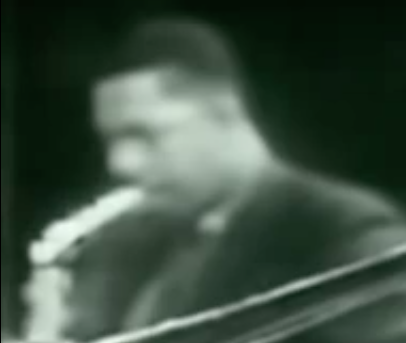
Above: John Coltrane on alto saxophone, à la Gerhard Richter.
Sunday, March 20, 2016
Konitz Coltrane Coincidence
In a recent performance with Tim Hagans and Dan Tepfer (following a conversation with Hagans), Lee Konitz played John Coltrane's "Resolution," kind of.

Hagans mentions the record Live at the Half Note, which features Jimmy Garrison. Speaking of connections between Konitz and Coltrane: on the tune "You Stepped Out Of A Dream" from that very record, Konitz quite clearly plays the first five notes of "Giant Steps," just about a month before Coltrane first recorded it. We hear it over E-flat7 / A-flat in bars 6 and 7 of the chorus that starts at about 4:37.

Surely these coincidences happen all the time, but this one stands out to me enough to be worth remarking—same pitch transposition, same even rhythm (quarter notes here instead of Coltrane's faster-tempo half notes). And some great stepwise voice-leading, of course. Note how the B-flat minor triad in the first bar is transposed up a semitone (in contrast to the typical tritone substitution) in the following bar; the F-sharp continues ascending by half-step (in octave displacement) to the leading-tone G and finally to the local tonic A-flat, as D and B implicitly also rise chromatically to fill out the A-flat major triad. There is meanwhile a higher-level descending fourth progression over the course of those three bars: D-flat – C-flat – B-flat – A-flat.
Saturday, January 30, 2016
Thursday, December 24, 2015
Lessons With Warne Marsh
"It's been really thirty years since there's been any major development in jazz, I think. Nothing's happened. There's no maturing of the music I heard in 1950. And yet it's opened up a really great potential, bebop did, not to mention Lennie [Tristano]."
Warne Marsh teaches at Troendelag Conservatory in Oslo in 1983:
Warne Marsh teaches at Troendelag Conservatory in Oslo in 1983:
Friday, October 16, 2015
Jackie McLean Pizza

Excellent taste! Jackie McLean Pizza & Jazz from "The Simpsons 138th Episode Spectacular," which aired in 1995.
Thursday, October 15, 2015
Noah Preminger, Pivot: Live at the 55 Bar
"…Of course, a musician that’s going to play any part of this music we call ‘jazz’ has to have a good understanding of what the blues is, and play the blues…” Jackie McLean
"As art it is savage and rough, but it lives — it weeps, nay it cries aloud, but it prays." J. K. Huysmans
"[Tradition] cannot be inherited, and if you want it you must obtain it by great labour. It involves, in the first place, the historical sense … the historical sense involves a perception, not only of the pastness of the past, but of its presence…” T. S. Eliot
"Soul is a complex interaction of feeling and intellect." Robert Musil
...
Tenor saxophonist Noah Preminger has released a new record, Pivot: Live at the 55 Bar, featuring Jason Palmer on trumpet, Kim Cass on bass, and Ian Froman on drums. Buy it.
Friday, July 31, 2015
Friday, June 26, 2015
"Brasilia" né "Neptune"
I have speculated that, due to its twelve-tone characteristics, the piece recorded by John Coltrane in 1961 and 1965 as “Brasilia” might have been written by or co-written with Eric Dolphy.
After all, “Miles’ Mode,” with its well-known twelve-tone row, was most likely written by Dolphy, who called it “The Red Planet.”
The meanings of the titles “Miles’ Mode” and “Brasilia” are easy to link to Coltrane — he was famously a member of Miles Davis’ quintet, and he showed an interest in Afro-Brazilian culture and music (see, for example, “Ogunde”).
Though “Brasilia” was originally issued as “Untitled Original,” Bob Thiele — the producer of the Village Vanguard recordings — referred to it in his logbook as “Neptune.”
So Dolphy’s title for “Miles’ Mode” was “The Red Planet” (Mars), and Thiele’s logbook for the 1961 Vanguard sessions listed “Brasilia” as “Neptune.” Do these appellative variations indicate anything about authorship?
We know of course that Coltrane was deeply interested in astrology. The answer to the question above is probably, “No.”
Probably.
Steve Lampert, "Zahskl's Jukebox, Volume 1"

At their respective zeniths, the spontaneous utterances in the tradition of American improvised music and the permutations of pitch, rhythm, and timbre available through the techniques of post-tonal composition and electronic music can offer intimations of infinity. Steve Lampert is a rare musician steeped thoroughly in each of these currents. Buy his new record, "Zahskl's Jukebox, Volume 1," in digital or physical format.
Friday, May 22, 2015
"Venus"
* * *
Please find this essay relocated here.
* * *
The cycle mostly descends (C-A♭-E) but also occasionally ascends (C-E-A♭). (See my previous discussion of harmonic tension in Coltrane cycles.)
A careful audition of "Venus" reveals that nearly everything that Coltrane plays is reducible to these three diatonic key centers.
Please find this essay relocated here.
* * *
"And for the heav'n's wide circuit, let it speak
The Maker's high magnificence, who built
So spacious, and his line stretched out so far;
That man may know he dwells not in his own;
An edifice too large for him to fill,
Lodged in a small partition, and the rest
Ordained for uses to his Lord best known."
Paradise Lost, VIII
John Coltrane's Interstellar Space is in my view a pinnacle of musical achievement. Each of its six pieces encompasses a galaxy of sonic meaning.
Lewis Porter's book John Coltrane: His Life and Music includes a transcription of Coltrane's saxophone playing on "Venus" (pages 283-7) as well as Porter's analytical overview of the piece. My own analysis alternately agrees and contrasts with Porter's. Since a thorough analytical treatment is not possible here, I offer instead a few comments.
"Venus" is, broadly speaking, tonal (not however in the Schenkerian sense of prolongation of a tonic triad) and teleological. The piece begins with the statement of a theme in the key of C; it leaves the tonic key and develops; and it returns to the initial theme in the tonic key of C.
Within that structure, "Venus" exhibits a cyclic harmonic form; namely, the major third interval cycle that is often associated with Coltrane. Specifically, the harmonic form of "Venus" comprises the diatonic collection with root transpositions of C, A♭, and E.
The cycle mostly descends (C-A♭-E) but also occasionally ascends (C-E-A♭). (See my previous discussion of harmonic tension in Coltrane cycles.)
A careful audition of "Venus" reveals that nearly everything that Coltrane plays is reducible to these three diatonic key centers.
As an example, take the initial departure from the C diatonic collection in line 7 of the transcription and 1:34 of the recording where major-third transpositions, smooth voice-leading, and harmonic gravitation combine in a microcosmic reflection of elements driving the piece as a whole. Here ♯^4 launches the transition away from the tonic, just as in common-practice music, approaching the dominant (G) via chromatically embellished lower and upper neighboring tones. These notes, though few, must nonetheless be heard in the context of the major third transpositions of the diatonic collection that, as I will show, so clearly dominate the piece. D♯/ E♭is the common tone pivot between the E and A♭diatonic collections represented here by four members each. Note that (F♯A E) and (E♭F A♭) are related by semitone transposition. (Below and throughout accidentals apply only to the note immediately following.)

Following standard jazz practice, Coltrane often melodically privileges the upper harmonic tones of the major diatonic collection — in particular the triad on the dominant. We must nevertheless be clear that Coltrane does not modulate to or tonicize the dominant — despite the frequent non-resolution of the leading tone (Coltrane's playing here, like most jazz, approaches pandiatonicism) — but remains in the key of one of the three major-third transpositions of the tonic. For example (lines 9-10, 1:45-1:56):




Just as Charlie Parker's myriad improvisational manipulations of "I Got Rhythm" changes represent a greater artistic achievement than George Gershwin's in composing them, Coltrane's masterful artistry lies not in the application of the major-third cycle but in the ways in which he elaborates, varies, and obscures it.

Following standard jazz practice, Coltrane often melodically privileges the upper harmonic tones of the major diatonic collection — in particular the triad on the dominant. We must nevertheless be clear that Coltrane does not modulate to or tonicize the dominant — despite the frequent non-resolution of the leading tone (Coltrane's playing here, like most jazz, approaches pandiatonicism) — but remains in the key of one of the three major-third transpositions of the tonic. For example (lines 9-10, 1:45-1:56):

In some cases, Coltrane tonicizes key areas related by step to one of the three structural transpositions of the diatonic collection, C, A♭, and E. For example (page 3 line 1, 3:55-4:01):

Melodic contour and the leading-tone C♯ tonicize a D minor harmony, the ii chord of the underlying tonic key of C. In the following example, Coltrane similarly uses the leading-tone to tonicize F minor, the vi chord of A♭(page 2 line 10, 3:25).

We also hear C♯ minor treated likewise as the vi chord in E.
At 3:28 (page 2 lines 10-11), Coltrane manipulates what at first seems like a non-tonal pitch-class collection, (A B C D♯ F). We should notice however that this set contains the tritone axes from the keys of C (B-F) and E (A-D♯), as well as the tonic itself, (C).

By the time we hear the last phrase on the second staff above, it becomes clear that the apparently non-tonal set preceding it is in fact a form of the Phrygian II in the key of E (F7 or tritone substitution on the dominant) and thus firmly within the C-A♭-E cycle that governs the entire piece.
In certain instances what appear on paper to be departures from the governing harmonic cycle are simply gestural figures that remain audibly within the basic three-key framework; otherwise, chromatic embellishment and inflection of the overwhelmingly diatonic harmonies, as illustrated above. The music of "Venus" is at no point "atonal."
As an example of the pervasiveness of the C-A♭-E cycle, we can follow the higher-level semitone ascent that Porter points out on page 2, lines 1-10 of the transcription, or 2:16-3:25 on the recording. The upper-voice G, held over from the opening theme, climbs by half-steps and continuously receives structural support as a chord tone (whether third, sixth, seventh, ninth, etc.) over one of the three main-key roots. These implied roots are given in the lower clef in the illustration below.

Passages of higher-level ascent by step are a significant organizing factor in other pieces from Coltrane's later music, such as "Transition." Though Porter does not to show it in his analysis, the ascent depicted above continues for the entire following page of the transcription, or until 5:47 on the recording; the concluding fourth interval is spanned not by semitones but by diatonic steps.


As shown above, the harmonic cycle is maintained throughout — though the key centers indicated under the quickly stated altissimo F♯ and G are only weakly implied; furthermore, between 4:19 and 4:33 a clear digression from the cycle, indicated with brackets above, takes place. This will be addressed in detail below.
After this large-scale ascent, Coltrane releases accumulated tension with a passage of astonishing beauty. Here the music also adheres strictly to the three-key framework. The three common tones between any two of the transpositions of the diatonic collection allow for a smooth and intriguing melodic traversal. From 5:57-6:29:

In the entirety of "Venus" there are only a handful of ambiguous cases which cannot be fundamentally explained in terms of the C-A♭-E cycle. For example, in the course of the higher-level semitone ascent that Porter points out in his analysis, Coltrane seems to digress very briefly into a new harmonic area while prolonging a top-voice E♭/D♯ (3:09-3:14, page 2 line 8):

(The example above reinstates an overtone note that is missing from Porter's transcription.)
Is this a dissonance created by suggesting a transposition of the cycle by a half-step? Or, is this mostly a chromatic elaboration of B dominant seventh, and therefore well within the basic key cycle? (Melodically, the phrase labelled "B7" perhaps most strongly implies E minor. We hear apparent E minor figures throughout "Venus," but primarily in the context of the C diatonic collection — i.e., E phrygian.) This phrase is different enough to stand out (the intervals D-B♭ and D-F♯ are absent from all three recurring diatonic transpositions), but maybe not enough to qualify as a true departure from the fundamental harmony.
Another brief but less ambiguous departure from the three-key framework is during the "recapitulatory" statement of the theme. Coltrane quickly and repeatedly cascades down a C major scale, and at 7:36-7:41 (page 5 line 4) he lowers the third and seventh degrees by a semitone to give the C scale a minor shading before shifting back to major mode. This harkens to the C-A♭relationship heard throughout the piece, but the retention of D-natural excludes that categorization.
In fact, there is only one instance in which Coltrane substantially and unambiguously diverges from the C-A♭-E key cycle. It is perhaps not a coincidence that this occurs during one of the most dramatic passages in the piece, as Coltrane leaps rapidly between the upper and lower registers of the saxophone, nearly two octaves separating successive notes. We hear this episode between 4:19 and 4:33, as mentioned above, during the long higher-level stepwise ascent and as the upper-voice C and then C♯ are prolonged.

Coltrane first moves away from the home cycle key of A♭ by adding a G♭. We can perhaps think of the pitch collection on the first staff as E♭ melodic minor, or A♭7#11 (tritone substitution?), moving by the end of the staff to G. Or we can simply follow the common tones and dynamic tones — C, D, and G♭/F♯ held in common, B♭ and E♭ sliding to B and E.
As we see on the second staff above, the G collection is then transposed to E♭, facilitated again by three common tones. On the third staff A♭ moves to A-natural, abolishing the sound of the key of E♭. The three-note motive (A B♭ C) is sounded twice, and then transposed up a semitone to (A♯ B C♯), evidently suggesting another major-third transposition from Eb to the diatonic collection on B. As the phrase continues, however, we find that B is not maintained. The collection on E returns; it is then colored as an F♯ chord with a suspended fourth and lowered 2nd and 6th degrees, then followed by A♭ and a clear reinstatement of the basic cycle.
Ultimately, the listener is left with the impression that in this passage Coltrane has transposed the fundamental major-third cycle by a semitone, from (C-A♭-E) to (G-E♭-B), creating a structural harmonic dissonance that is underscored by the outstanding registral displacement that initially accompanies it.
***
The form of "Venus" can be broadly outlined as follows:
:32-1:34 — statement of the theme
-2:16 — initiation of development
-5:47 — prolongation of stepwise ascent
-6:29 — descent and release
-7:06 — fragmentation; overtones and gestural note flurries
-8:16 — return of the theme; "recapitulatory development"
Despite its status as a paragon of "free jazz," it is clear that Coltrane's improvisation on "Venus" is thoroughly informed throughout by a harmonic cycle of specific major-third transpositions of the diatonic collection. I make no claim as to Coltrane's intent; but since the musical surface falls within the "scalar tradition," I believe that the analytical approach I offer here provides considerable utility.
Just as Charlie Parker's myriad improvisational manipulations of "I Got Rhythm" changes represent a greater artistic achievement than George Gershwin's in composing them, Coltrane's masterful artistry lies not in the application of the major-third cycle but in the ways in which he elaborates, varies, and obscures it.
In merging a teleological formal arc characteristic of Western classical music but absent from most jazz with a repetitive, cyclic form typical of jazz as well as many African and other folk and dance musics, Coltrane's "Venus" represents a truly rare musical breakthrough. While Interstellar Space hardly admits comparisons, the syncretic formal approach I point to in "Venus" in some sense parallels the rotational sonata form of Sibelius's Symphony No. 5.
Thursday, May 14, 2015
Kim Cass, "Kim Cass"
“We think we have to talk about aesthetic judgements like ‘This is beautiful,’ but we find that if we have to talk about aesthetic judgements we don’t find these words at all, but a word used something like a gesture, accompanying a complicated activity.”
“In what we call the Arts a person who has judgement develops … We distinguish between a person who knows what he is talking about and a person who doesn’t.”
You won’t generally find record reviews here. But since most of the jazz gabbers still haven’t got around to mentioning it, I'd like at least to repost my Twitter commentary:
Kim Cass http://t.co/c7QFJu8VXG holy moly
— dan voss (@dan__voss) February 1, 2015
In terms of instrumental, compositional, and conceptual virtuosity, the new record from bassist Kim Cass has in my view broken new ground. Buy it.
Friday, April 17, 2015

Thursday, February 26, 2015
A Mystical View, Some Quarter Century Before "Interstellar Space"
"Art has no immediate future because all art is collective and there is no more collective life (there are only dead collections of people), and also because of this breaking of the true pact between the body and the soul. Greek art coincided with the beginning of geometry and with athleticism, the art of the Middle Ages with the craftsmen's guilds, the art of the Renaissance with the beginning of mechanics, etc. ... Since 1914 there has been a complete cut. Even comedy is almost impossible. There is only room for satire (when was it easier to understand Juvenal?). Art will never be reborn except from amidst a general anarchy—it will be epic no doubt, because affliction will have simplified a great many things. ... It is therefore quite useless for you to envy Leonardo or Bach. Greatness in our times must take a different course. Moreover it can only be solitary, obscure and without an echo... (but without an echo, no art.)" - Simone Weil, Gravity and Grace
Tuesday, February 10, 2015
Blues: Coltrane, "Mars" and Harris, Symphony No. 7
The substrate for the best American music is the blues (including van der Merwe’s broader notion of the “popular style”), even when the musician in question is a mid-20th century symphonist: note the variable third in the cello right from the start of Roy Harris’s Symphony No. 3.
Or take, for example, the strikingly and perhaps unexpectedly similar descending gestures, clearly identifiable as "blues" (4 -♭5 - 4 -♭3 - 1), that end local phrases in both John Coltrane’s “Mars” from Interstellar Space (1967) and Roy Harris’s Symphony No. 7 (1955) — at 1:26 and 6:33, respectively, of the recordings below. (Harris's figure continues with one extra tone, the lower ♭7.)
Friday, January 30, 2015
Alto Genealogy
Rudy Williams, Charles Mingus’s cousin, with Tadd Dameron’s band at the Royal Roost in 1948 — a precursor to Eric Dolphy?
Monday, January 26, 2015
Pete La Roca's (Old) Boom Bap
Every time I listen to John Coltrane Quartet's "Liberia," recorded live at the Jazz Gallery in (June of?) 1960, I am a bit surprised to hear what Pete La Roca plays from 4:55 to 5:09. It always strikes me as wonderfully anachronistic, not quite of its time. (Perhaps one could say the same thing about most of what is played here by Coltrane and the quartet generally.)
Those better versed in the musical history of the drumset are invited to comment and disabuse me of my misapprehension.
Those better versed in the musical history of the drumset are invited to comment and disabuse me of my misapprehension.
Friday, December 12, 2014
Emergent Tonal Structure in the Transpositions of the "A Love Supreme" Motif
This week marked the fiftieth anniversary of the recording of John Coltrane's A Love Supreme. As part of his Twitter homage to that record, Miles Okazaki tweeted the transpositions of the "A Love Supreme" motif—set-class (025)—in the key of the tenor saxophone.
Ethan Iverson replied to point out that this sequence exhibits full chromatic saturation. Okazaki responded with a quote from Ravi Coltrane, and a photo from John Coltrane's score indicating that the inclusion of transpositions through all twelve keys was intentional.
I answered by listing the transpositions in terms of interval class, which highlights how transpositions by whole-steps and fourths (ic2 and ic5) predominate. As Lewis Porter showed, these intervals—which also comprise the set-class (025)—underlie the composition of the entire suite.
We could certainly speculate about why Coltrane found it necessary to "move freely" "in all 12 keys." But perhaps the indication in his score to "start & end in E♭ concert minor" is more suggestive. Indeed, I find myself inclined to hear the sequence of transpositions—despite the chromaticism—as fairly tonal in its higher-level voice-leading.

Coltrane's transpositions of the (025) motif initially outline an F minor triad. There is a step-wise ascent to the third, with the second scale-step G expanded by its lower dominant, and the fifth, displaced to the lower octave, is approached by its upper neighbor D♭. Next the seventh is reached by step, extending the tonic F minor triad to a seventh chord.
The transpositions then proceed through two clicks on the circle of fifths to the submediant, D♭. To my hearing, this previously-foreshadowed upper neighbor (indicated by the flags above) to the fifth degree of the tonic F minor is prolonged and transferred to the lower register. The rising fourth of A♭ to D♭ is repeated as a transposition up a semitone and expanded by arpeggiation from the lower third. I have spelled this "D minor triad" enharmonically as E♭♭ to indicate that it can be heard to function as a Phrygian II to the prolonged D♭, and because the preceding D♭ does not sound merely like a chromatic neighbor but is additionally reinterpreted as a leading tone. Subsequently, Coltrane returns to the A♭/D♭ pole and inverts it to prolong a descending D♭ minor triad, embellished by leaps up to the seventh.
At this point the initial ascent through the F minor seventh chord is roughly reversed. The original register is reinstated and E♭ falls back to C, which is immediately preceded by the only instance of the subdominant, B♭. Then, as earlier, the second scale degree is expanded, this time as a prolongation of the dominant of the dominant through a step-wise ascent from the lower fifth. Finally, A♭ falls to tonic F to complete the structure in appropriate blues fashion.
While Coltrane's sequence does not by any means possess a typical Schenkerian structure, its voice-leading nonetheless evokes a tonal outline. Rather than construct a step-wise Urlinie, Coltrane stacks thirds in a manner common both in his music and to blues music generally; a central elaboration follows, then a very roughly symmetrical return. (In the graph below, parentheses indicate that the register has been idealized.)

Coltrane may have been "moving freely" through these transpositions, but the resulting music is hardly "random." The higher-level voice-leading reveals an emergent tonal structure which shows Coltrane's improvisation on A Love Supreme to be as ordered and coherent as his composing.
F G D Ab Db C D Eb Ab Db A F D Ab B E B Db Eb Bb C G D E Gb G Ab F (the modulations beginning at 4:54) #ALoveSupreme50
— Miles Okazaki (@milesokazaki) December 9, 2014
Ethan Iverson replied to point out that this sequence exhibits full chromatic saturation. Okazaki responded with a quote from Ravi Coltrane, and a photo from John Coltrane's score indicating that the inclusion of transpositions through all twelve keys was intentional.
@milesokazaki As you know, this has all 12 keys. Any other mathematical reason for this particular sequence? cc: @dan__voss
— Ethan Iverson (@ethan_iverson) December 9, 2014
@ethan_iverson I've heard differing opinions. In Kahn's book, Ravi says "deliberately random." Coltrane's score says: pic.twitter.com/FDDwvDSi3Z
— Miles Okazaki (@milesokazaki) December 9, 2014
I answered by listing the transpositions in terms of interval class, which highlights how transpositions by whole-steps and fourths (ic2 and ic5) predominate. As Lewis Porter showed, these intervals—which also comprise the set-class (025)—underlie the composition of the entire suite.
.@ethan_iverson @milesokazaki Transpositions by interval class: 256512155443635522525522113 Steps &fourths prevail as elsewhere in the suite
— dan voss (@dan__voss) December 9, 2014
We could certainly speculate about why Coltrane found it necessary to "move freely" "in all 12 keys." But perhaps the indication in his score to "start & end in E♭ concert minor" is more suggestive. Indeed, I find myself inclined to hear the sequence of transpositions—despite the chromaticism—as fairly tonal in its higher-level voice-leading.
Coltrane's transpositions of the (025) motif initially outline an F minor triad. There is a step-wise ascent to the third, with the second scale-step G expanded by its lower dominant, and the fifth, displaced to the lower octave, is approached by its upper neighbor D♭. Next the seventh is reached by step, extending the tonic F minor triad to a seventh chord.
The transpositions then proceed through two clicks on the circle of fifths to the submediant, D♭. To my hearing, this previously-foreshadowed upper neighbor (indicated by the flags above) to the fifth degree of the tonic F minor is prolonged and transferred to the lower register. The rising fourth of A♭ to D♭ is repeated as a transposition up a semitone and expanded by arpeggiation from the lower third. I have spelled this "D minor triad" enharmonically as E♭♭ to indicate that it can be heard to function as a Phrygian II to the prolonged D♭, and because the preceding D♭ does not sound merely like a chromatic neighbor but is additionally reinterpreted as a leading tone. Subsequently, Coltrane returns to the A♭/D♭ pole and inverts it to prolong a descending D♭ minor triad, embellished by leaps up to the seventh.
At this point the initial ascent through the F minor seventh chord is roughly reversed. The original register is reinstated and E♭ falls back to C, which is immediately preceded by the only instance of the subdominant, B♭. Then, as earlier, the second scale degree is expanded, this time as a prolongation of the dominant of the dominant through a step-wise ascent from the lower fifth. Finally, A♭ falls to tonic F to complete the structure in appropriate blues fashion.
While Coltrane's sequence does not by any means possess a typical Schenkerian structure, its voice-leading nonetheless evokes a tonal outline. Rather than construct a step-wise Urlinie, Coltrane stacks thirds in a manner common both in his music and to blues music generally; a central elaboration follows, then a very roughly symmetrical return. (In the graph below, parentheses indicate that the register has been idealized.)
Coltrane may have been "moving freely" through these transpositions, but the resulting music is hardly "random." The higher-level voice-leading reveals an emergent tonal structure which shows Coltrane's improvisation on A Love Supreme to be as ordered and coherent as his composing.
Friday, November 21, 2014
Apophatic Music
"Music is a movement of nothing in a space that is nowhere, with a purpose that is no-one's, in which we hear a non-existent feeling the object [and subject*] of which is nobody. And that is the meaning of music."
Roger Scruton, Perictione in Colophon
[*added in The Soul of the World]
Sunday, November 16, 2014
Art Taylor on Art and Academics
“The student in the university will avail himself to many other facets of music that I didn’t even consider when I was playing. For instance, playing different instruments. Learning how to read, and read in a manner that would enable him to play in a classical situation, Western classical situation, and an Afro-American classical situation. We have to get into these terms now. You notice I’m using these terms because these were the terms that were thrown at me when I arrived on the academic scene. ‘Legitimate’ music, ‘serious’ music. Making an inference that music that wasn’t Western classical music wasn’t serious or wasn’t legitimate. So I have used that term, what they call jazz, I call that a classical music. It’s an American classical music.”Jackie McLean (quoted above) is of course correct: in its greatest manifestations, jazz is art music. But it is not always—nor even usually—that, and more importantly, it is not only that. Art Taylor explains below.
...
"Art on art"
(Peter Pullman interviews Arthur Taylor)
PP: Does jazz go through cycles? Is it some precious resource that has to be conserved? I worry about the people who have appointed themselves to "save" jazz.
AT: Well that's related to my theory about people who say to me, "You're a great artist." I'm not an artist. I don't consider myself an artist. Charlie Parker was an artist. Bud Powell was an artist. I'm a drummer and I just play the drums—but people talk about this as an art form. It's not an art form; I used to play for whores and pimps—and I enjoyed playing better for them than I do for the crowd that comes now. Because they were swinging people, everybody was having fun. It wasn't about sitting down and playing, and the people sitting there in a trance, getting some special messages from somewhere that nobody was even delivering. And I've played for the whores and the pimps and when I got off the bandstand it's "Hi, how are you doing? Have a taste with my lady and me."
PP: So you are an entertainer.
AT: Yeah, I'm an entertainer. I believe in entertaining people. But that's a very difficult thing, to just play some instrument and be entertaining. Very few people can do that. A lot of guys are out there playing a whole lot of stuff but it's not entertaining. When you go home you don't even remember what they've played. And you can't hum it either. [Laughs.]
PP: So the guys who not only entertained on an instrument but could also create art... you are talking about only a handful.
AT: Yes, Dizzy, Bud, and Bird—Bird was quite an entertainer. I use all of Dizzy's, Bud's, and Bird's stuff, their mannerisms. And I can put in on and I can really be with it—or I can put myself into it, or I can take it any kind of way.
PP: Some people feel jazz needs an academy, an institution that will protect it—by including what it defines jazz is and excluding what jazz is not. Yet Philly Joe said in your book: "Music changes around and changes around. It takes all kinds of turns but it always comes back to the pure swing."
AT: That's what Taylor's Wailers do.
PP: "Nothing seems to outlast jazz," he continues. "The real, true, traditional jazz... you can't get away from it. People like to pat their feet and clap their hands."
AT: That's correct, not sit there like a bunch of mummies.
PP: So it's not some solemn art thing, Art?
AT: No, not to me, it's supposed to be a fun thing. I'm trying to play it pure and swing and have fun and make people feel good.
PP: And Philly Joe is saying that has always been the case, that jazz is not endangered?
AT: I don't think it is. Jazz doesn't have cycles; musicians who can play can still play. You either can play or you can't play.
PP: So we don't have to keep some sort of standard for what jazz is and define it all the time lest it gets diluted?
AT: I keep the standard.
PP: But the standard is when you are sitting on the drum stool with the musicians who are out there and you're pushing them, that's where it comes in. It's not an academic thing, is it?
AT: No, it's not an academic thing. If we come off the stage and we are not laughing, nothing happened. If guys are coming off like they've come off some kind of seance, having done some "brilliant" thing... if you are not laughing, it ain't shit. Wasn't shit happening. See how the bands walk off the stage.
PP: So is that tradition dying, is that sense that this is about fun being lost?
AT: I don't know, maybe it's dead but I continue to play in my same manner... They're trying to refine it, but those old brilliant minds in my race came out of this music anyway.
...
The above is excerpted from an interview of Arthur Taylor conducted by Peter Pullman in 1992. It is included in the liner notes to Arthur Taylor's Wailers, Wailin' at the Vanguard. Buy it here. Buy Notes and Tones. Buy Peter Pullman's book, Wail: The Life of Bud Powell.
Subscribe to:
Posts (Atom)